Residential yards in Columbia present ideal microclimates for vector arachnids due to high relative humidity and mature landscape canopies. In historic Shandon and Old Shandon, mature oak canopies deposit thick leaf…
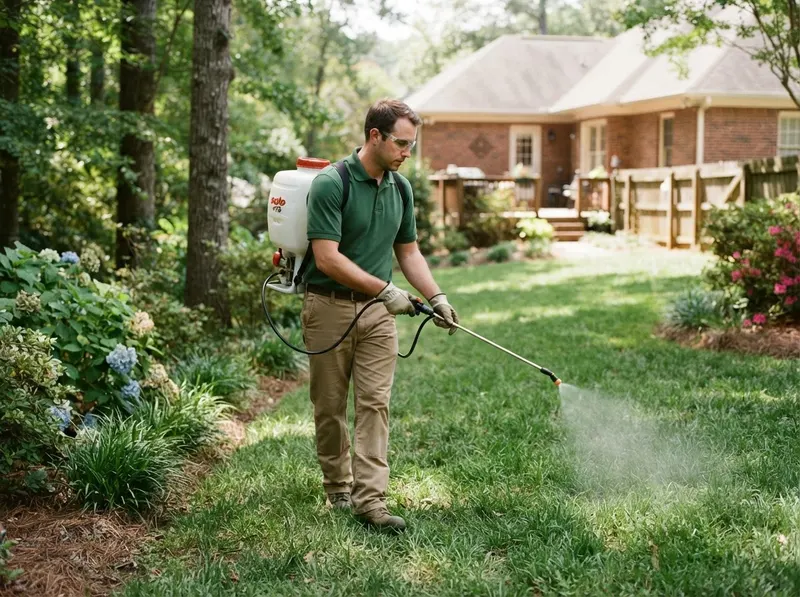
Residential yards in Columbia present ideal microclimates for vector arachnids due to high relative humidity and mature landscape canopies. In historic Shandon and Old Shandon, mature oak canopies deposit thick leaf litter where blacklegged ticks quest for hosts along landscape beds. Suburban properties backing up to drainage easements in Rosewood, Forest Acres, and Hollywood-Rose Hill encounter lone star tick pressure carried by urban white-tailed deer corridors.
Applying targeted residual barrier sprays to low-lying ornamental vegetation breaks this cycle without applying chemicals inside living quarters or family gathering spaces.
Tick suppression differs technically from standard mosquito spraying. While adult mosquitoes rest on the undersides of broadleaf foliage 4 to 10 feet off the ground, ticks remain largely within 18 inches of the soil surface in shaded moisture sinks, English ivy, and damp pine straw beds.
Properties in Cottontown and Elmwood Park often feature narrow property lines bordered by shade-tolerant ground covers that harbor tick nymphs. Treatment relies on low-pressure hydraulic ground applications that penetrate heavy mulch beds rather than broad aerial mists that drift. S.
Environmental Protection Agency outlines integrated pest management principles prioritizing localized applications over untargeted dispersion.
Subterranean microclimates in Earlewood and Heathwood require structured habitat modification alongside liquid barrier treatments. Ticks undergo desiccation rapidly when exposed to direct midday sun and dry soil surfaces.
edu/entomology/">Michigan State University Department of Entomology. html">South Carolina Department of Natural Resources highlight how urban deer and small mammal migrations transport tick burdens through suburban greenbelts.
Seasonal control sequences depend on accurate tick life-stage timing.
Larval and nymphal ticks emerge in spring, while adult host-seeking spikes during cooler autumn months. org/">Entomological Society of America emphasizes treating ground boundaries during early instar phases to prevent reproduction. org/">National Association of Landscape Professionals to design low-risk boundaries.
org/">Association of State and Territorial Health Officials advocate for sustained barrier protection over single reactive treatments. org/">Lady Bird Johnson Wildflower Center assist in balancing native vegetation with clear buffer zones.
Every job gets a firm, written price after a free on-site visit.
Tell us about your tick yard treatment job in columbia and we'll send a clear, written quote, usually the same day.
 MeadowPeak Pest Experts