Carpenter ant structural remediation stops active wood excavation before hollowed wall plates and floor joists compromise residential framing. Unlike subterranean termites that ingest cellulose, carpenter ants carve…
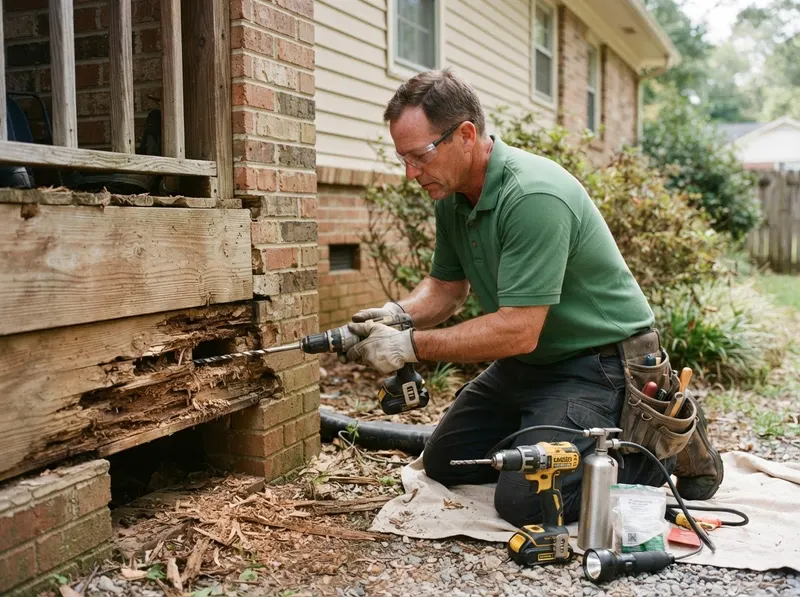
Carpenter ant structural remediation stops active wood excavation before hollowed wall plates and floor joists compromise residential framing. Unlike subterranean termites that ingest cellulose, carpenter ants carve smooth nesting galleries into damp wood, often leaving coarse wood shavings known as frass on subfloors or behind baseboards. In older Columbia neighborhoods such as Cottontown, Elmwood Park, and Earlewood, historic heart-pine and crawlspace sill plates frequently absorb humidity from the Congaree River basin. When high ambient moisture combines with plumbing condensation or roof flashing wear, satellite colonies migrate from nearby hardwood trees into wall cavities. Remediation isolates these nesting chambers using precision void injections rather than broad indoor broadcasting, preventing chemical tracking through living rooms and preserving clean indoor spaces.
Selecting structural remediation fits scenarios where wood shavings accumulate, large black winged swarmers emerge near windows, or rhythmic rustling noises occur inside drywall during quiet evenings. If wood damage reveals packed soil or mud tubes rather than polished, clean-carved galleries, the underlying problem is subterranean termites rather than ants, requiring a distinct trenching protocol. Choosing localized structural remediation over recurring monthly maintenance contracts prevents unnecessary expenses, as parent colonies usually exist outdoors within dead limb stubs while indoor voids house secondary satellite nests. Remediation targets the specific biological bridge connecting these environments. MeadowPeak Pest Experts utilizes targeted perimeter defenses aligned with modern Integrated Pest Management principles established by environmental standards to resolve the source without blanket indoor treatments.
Proper execution follows a three-step clinical sequence that protects structural members and yard ecosystems: 1. Moisture mapping and thermal detection locate hidden gallery networks around bathrooms, kitchen pipe penetrations, and crawlspace headers. 2. Non-repellent liquid actives and pressurized micro-dusts are injected directly into targeted wall voids, allowing foraging workers to transfer the active material to the queen via social food sharing as outlined by the NC State Extension Forestry and Entomology guidelines. 3. Exterior foundational bands receive a protective perimeter barrier up to two feet up the foundation wall, sealing structural entrance points against surrounding canopy trails. For crawlspaces with persistent moisture, homeowners often consult the South Carolina Department of Public Health for home moisture guidance or structural guidelines from the Clemson University Cooperative Extension. Building envelope protocols align with standards from the U.S. Department of Housing and Urban Development and venting standards maintained by the International Code Council to ensure crawlspace humidity remains below critical decay thresholds.
Suburban residences across Rosewood, Shandon, and Forest Acres experience elevated carpenter ant activity due to mature water oak and sweetgum canopies overhanging asphalt shingle roofs. When wind-driven storms roll across the Midlands, cracked limbs provide moist staging areas for parent colonies, which trail along utility lines or tree limbs touching fascia boards. Properties bordering parklands like Sesquicentennial State Park or urban creek beds face higher natural migration rates. In Heathwood and Melrose Heights, remediation often requires tracing exterior trails along landscaping timbers and boundary fences. Proper remediation strictly separates living areas from chemical exposure by leveraging non-volatile treatments certified through the South Carolina Department of Agriculture, while structural wood considerations coordinate with standards from the American Wood Council, workplace standards enforced by Occupational Safety and Health Administration, and ecological parameters evaluated by the U.S. Fish and Wildlife Service.
Every job gets a firm, written price after a free on-site visit.
Tell us about your carpenter ant structural remediation job in columbia and we'll send a clear, written quote, usually the same day.
 MeadowPeak Pest Experts